

WORLD FROM NANO TO PICO
Introduction
The technology in the world, is formed with many devices which we use regularly to reduce human efforts on works they do, there are many such devices from a 'scientific calculator' to the complex machines like 'satellites' the evolution of the technology depends on the ideas and making that ideas work without any fail. In this we learn about the processors, their working and the evolution of the processors based on the size of their gates and also the latest technology where impossible is going to be possible with coming new processors.
History of the processors
As all know we used the transistors in the early ages to transfer the outputs or to calculate the values. There are so many variants of transistors which carries from 4 bit to 64 bit and also the clock speed according to that for every generation of processors. First there are transistors used in many devices to work...,for example: basic calculator, to calculate the values and to give the output. Then the evolution began with the integrating method that we are learning as 'Integrated circuits'. Now the various technology and some special methods are used to make the processors more powerful competing the present devices or networks.
The first Integrated circuit was developed by Robert noyce of Fairchild semiconductor and Jack kilby of Texas instruments it was demonstrated on 1958.
After all the research the first microprocessor was introduced in the year of 1971 by Intel with the help of Tedd hoff. That was the 'Intel 4004'.It had 2,300 transistors, performed 60,000 operations per second(OPS). addressed 640 bytes of memory.
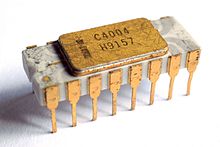
Image of Intel 4004 (Image source:Google)
After the release of the first microprocessor Intel, AMD and Cyrix companies made several experiments on the Integrating technology. Made processors from 45nm(Nanometer), Intel introduced first 45nm chip called Xeon 5400 series in the year 2007.
Then all other chip manufacturers including Intel worked on the Nanometer technology(10 exp -9) Chip sets, that included all the Intel 32nm, 24nm, 18nm. Then Intel introduced 14nm technology which uses second-generation, tri-gate transistors, which lead the industries with the performance with decent power consuming and also the fast processor ever manufactured.Now we look at the present scenario and what actually Nanotechnology works.
Present scenario(Nanotechnology):
Can you guess what actually the size of nanometer is....!?
Yeah, obviously we know it is (10 exp -9) but when we compare it to real world example, he human hair is around 50,000nm thick, and now we are going to learn something about only 7nm we use in our daily life, that is the nanotechnology in computers.
Later on the microprocessors are not only the chips for the computers, but they served the Mobile phones too with this technology. The smartphones which involves high features and commands usually want the very fast processors and also less in size, this initiative is taken by some companies like Samsung(Exynos SoC), Qualcomm(Snapdragon SoC), Apple(Bionic SoC), Mediatek(Helio Soc), are some famous mobile chipset manufacturers.They manufactured very powerful processors till to date. The present scenario of the processors and the supportive features are discussed.
Like the Intel, AMD, ARM and Shakti(India) and some other computer using processors, the mobile processor manufacturers are also moving in rapid by making very powerful processors, which also run on the base of Nanotechnology.

Checkout the above link to know more about Nanotechnology in brief.
The 5th generation of mobile network (5G) :
The present industries are manufacturing their chips on the basis of 14nm, 12nm and 7nm. These are running in all premium mobile phones which has 4G and also the upcoming 5G network.The minimum specifications of the processor that supports the 4G network is as follows.
Example: The Qualcomm Snapdragon 435 SoC is the processor which supports the 4G network that has the specifications like.
CPU clock speed : Up to 1.4GHz(Giga hertz)
CPU cores : 4X Arm cortex A53, Quad-core CPU
CPU Arcitecture : 64-bit
Process Technology : 28nm LP(Low power)
Wi-Fi spectral Band : 2.4GHz , 5GHz
Peak speed : 433 Mbps
But now the processors of the above specifications are outdated, now the processors are running on the technology of 7nm, which is far away from the above 28nm devices.
In the mobile world the processor which supports the 5G network is introduced by Qualcomm Snapdragon and it is the SD(Snapdragon) 865+ chip set.
In India most probably Jio network will be the first to develop a 5G solution from scratch.
Specifications of SD 865+ SoC:
CPU clock speed : Up to 3.1 GHz
CPU cores : Qualcomm 'kyro' 585 CPU
CPU Architecture : 64-bit
Process technology : 7nm
Wi-Fi spectral band : 6 GHz
Peak download speed : 7 GBPS
Peak upload speed : 3GBPS

Advantages of 5G technology:
- Greater speed in the transmissions
- Lower latency, so great capacity of remote execution
- Greater number of connecting devices and the possibility of implementing virtual networks(network slicing)
Nanotechnology in other fields:
Not only in the computer or mobile world the Nanotechnology has its role in other fields like Medical, Automobiles etc...,
MEDICAL:
In medical field now the nanotechnology is going to make the way by getting evolved into it there are such diseases that can be cured with the help of this technology,
These are known as Nanobots.
Nanobots work is to releasing drugs that travel to exact location if disease these are also called as Nano medicine. Actually they are programmed according to the disease and the drug it releases, most complex therapies are going to done by this Nanobots. Here we get to see a robot which is tiny, entering our body and the treatment is done by it....., yes, it is possible.

AUTOMOBILE:
In automobile industry the Nanotechnology is used to make the fiber glasses for cars trucks and other components, which lasts long. As the glass or fiber are integrated just as the transistors or the semiconductors done, and this makes the material even stronger.

Processors used in Rockets and space shuttles
Keeping other uses aside now we learn about some interesting thing, have you ever wondered what processors or the technology that used in Rockets or space shuttles,
The SpaceX claims that vehicle's each dragon spacecraft is equipped with 3 flight computers. Each of these run on a dual-core x86 processor.
In ISRO's proud mission Mangalyaan known as MOM(Mars orbital mission) a 16-bit computer instruction set architecture(ISA) is used i.e..., Dynex MAR31750 based on MIL-STD-1750 (Military standard 1750) is used.
ISRO introduced a processor called 'Vikram' to guide future rockets.
Actually Rockets uses the Supercomputers nothing but, all the processors makes a big system or the processing unit (CPU) is known as supercomputers.., and that processors are again the 7nm technology one, which we use in our regular devices

Future with Nano and evolving to Pico:
As of now we came to know about the latest technologies that is based on Nanotechnology, the future is even more shrinking from 7nm to 5nm. The manufacturers like Intel, Qualcomm and other industries claims that this technology is even more faster than any other.
Process technology of 5nm and 3nm:
The 5nm processor is begun by Samsung electronic and Taiwan semiconductor manufacturing comapny(TSMC) 5nm Fin field effect transistor(FinFET), with limited risk production, and planning to begin mass production in future, as we all know about the Moore's law(It is a observation that the number of transistors in a dense Integrated circuit (IC) doubles about every two years.
So, it is said that there will be a end for this Moore's law with the beginning of the 5nm process technology. It is assumed because Transistors smaller than 7nm, will experience Quantum tunnelling through the great Oxide layer. The demos are already done by IBM and also the TSMC.
Coming to the 3nm technology it is the next die-shrink after the 5nm MOSFET technology node, it is based on GAAFET(gate-all-around field effect transistor).

THE PICO(10 exp -12):
From the heading you thought of it correctly...., We are in the future. So, lets discuss some stuff which is related to the Pico technology what type of devices or new technologies we are going to witness in the future that satisfies the human needs even more better, after the 1nm process technology the question arises what is beyond the 1nm.
As there are many other questions about the technology and what miracles are going to happen in the future technology with these Picometer process technology, how the supercomputers are going to integrate from the present Nano to Pico? and what are their functionalities compared to the present technology? there are no answers, but it is interesting learning the stuff which is beyond us right....,!


0 Comments